
Discover the 3-6-9-12+ milestones





📍 The 3-6-9-12+ milestones
In 2008, Serge Tisseron launched the 3-6-9-12+ guidelines to help parents know at what age and in what way to introduce screens into their child’s life. In 2020, he created the 3-6-13-18 milestones (in French) to address the risks that artificial intelligence poses to the development, imagination and mental health of children and teenagers.
The 3-6-9-12 guidelines in 2008
- No screens before age three.
- No personal digital device before age six (children may use a family tablet or games console if their parents allow it, but they should never own the device, because it then becomes very difficult to limit its use).
- No Internet without an adult before age nine: from that age on, children discover the Internet with an adult by their side.
- No Internet on their own before their 12th birthday. This means not giving a child a smartphone before age 13, since owning a smartphone gives access to the Internet.
The principles
These guidelines, sometimes also called “milestones”, rest on three principles that apply at every age, which I have called the “triple A”:
- Accompany children in all their activities, with or without screens.
- Alternate activities with and without screens.
- Autoregulation: teach children to regulate themselves. Although self-regulation only fully matures around the age of 25, children begin to internalise behavioural landmarks much earlier, as shown by the way they learn the rituals that go with eating in every culture and every family.
Four pieces of advice follow from these three principles:
- Choose quality programmes together with the child, especially if they are allowed to watch television between the ages of three and six.
- Limit screen time, and set a good example for children by limiting our own.
- Talk with our children about what they see and do with screens, to show them that we are interested in what they do, and develop their language through the answers they give us.
- Encourage creative activities with or without screens, especially digital photography from the age of seven or eight.
The 3-6-9-12+ milestones today
In the 2010s, we felt it was important to rephrase the same advice in a positive way without changing its substance, with an emphasis on accompanying children so that they learn to guide and protect themselves in digital worlds.
The 3-6-9-12 guidelines became 3-6-9-12+ to convey the idea that it is important to regulate our screen use at every age, and also that we must now take into account the new issues raised by AI (see the 3-6-13-18 milestones, in French).
Under 3: let’s play, let’s talk, let’s switch off the TV.
At this age, children build their personality and their brain. The more time they spend in front of screens, the less they have for creative play, interactive activities and other fundamental social and cognitive experiences. Skills such as sharing, appreciating and respecting others, which take root in early childhood, are put at risk.
At this age, children must acquire the four foundations of their future socialisation: language, motor skills, attention and concentration, and the recognition of facial expressions.
Screens do not help these skills.
These skills only develop through a living, interactive relationship with an adult or another child.
Our advice: never leave a child in front of a screen, or in a room where a screen is on. This does not prevent you from occasionally playing with them using a fun app, but only for a very short time, and always together.
From 3 to 6: let’s limit screens, share them and talk as a family
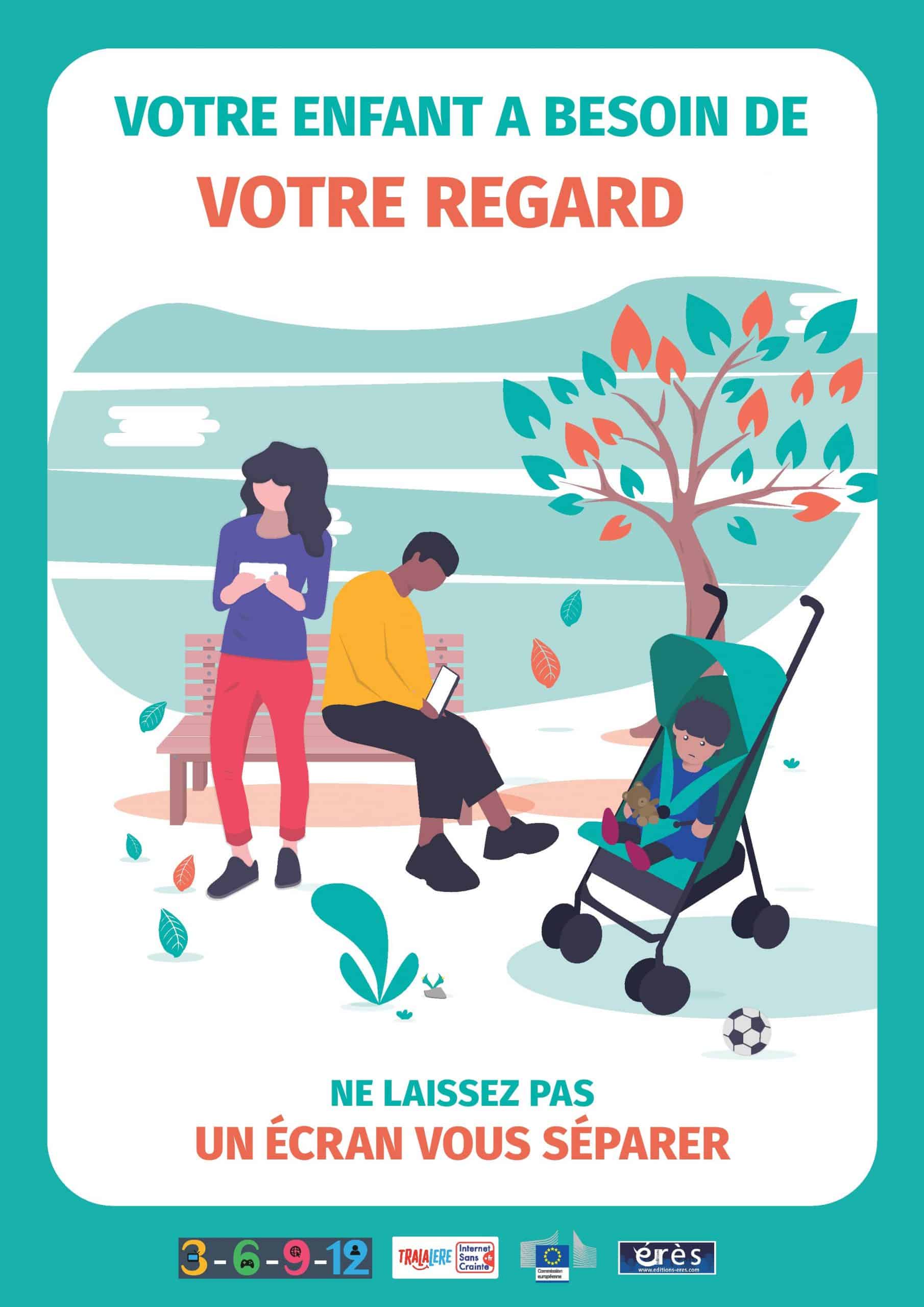
At this age, children consolidate what they have learnt and begin learning to regulate themselves. Limits on screen time should be part of this: from half an hour a day at age 3 to one hour a day at most at age 6. Screen time is time shared with a parent.
Never a screen in the bedroom: screens should be in a shared room. Let’s also avoid using them in the evening (LED light disrupts sleep patterns), at mealtimes or to calm the child down.
The slogan “no personal console before 6”, launched in 2008 as part of the “3-6-9-12” campaign, means not giving a child their own digital device before age 6, because that makes it almost impossible to regulate. Digital devices should belong to the family.
It is also important to set a daily time slot for the child, so that they get used to associating screens with a set amount of time.
Finally, let’s not forget to encourage physical activities and hands-on creative activities such as folding, cutting, gluing, cooking, DIY…
Our advice: share screen time with your child, and talk with them about what they see and do on screens.
From 6 to 9: let’s create with screens and explain the Internet
Between 6 and 9, children learn the rules of social life.
Let’s buy our child a digital camera, and explain to them the right to privacy and image rights.
Let’s take an interest, and get our child interested, in the digital creation tools available: Scratch, stop-motion software. Let’s invite the child to create with screens.
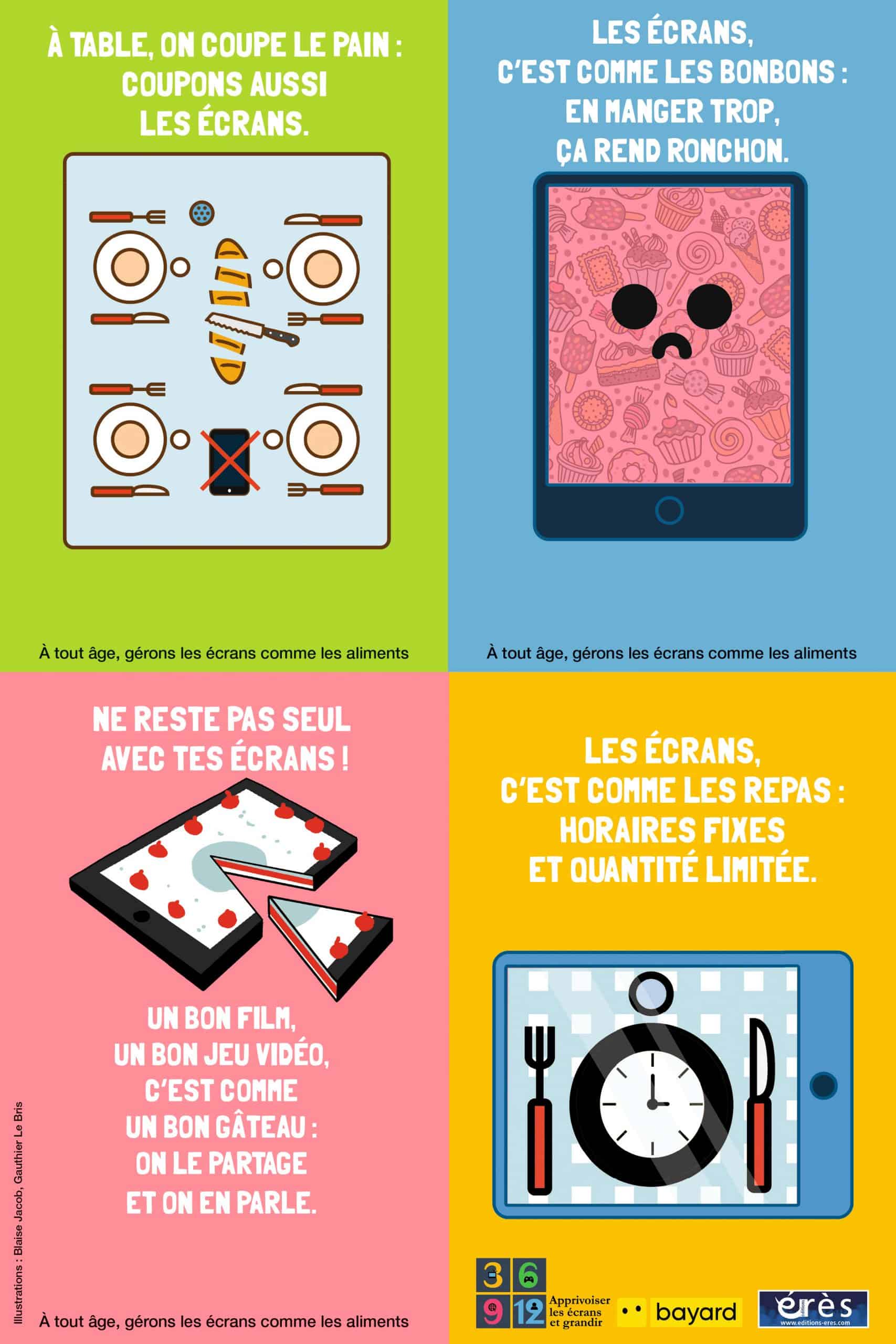
Let’s also start discussing the age at which they will get their first mobile phone, and set family rules that everyone respects, in particular no phones during meals and none at night.
Our advice: every bedroom should have an alarm clock!
From 9 to 12: let’s teach them to protect themselves and their exchanges
Children who spend a lot of time in front of screens show a decline in attention and concentration. Their brain gets used to following or chaining movements or actions rather than deliberately focusing on a task.
Let’s encourage the child to manage their recreational screen time, for example with a “screen-time notebook”.
Let’s also talk with them about what they see and do with screens.
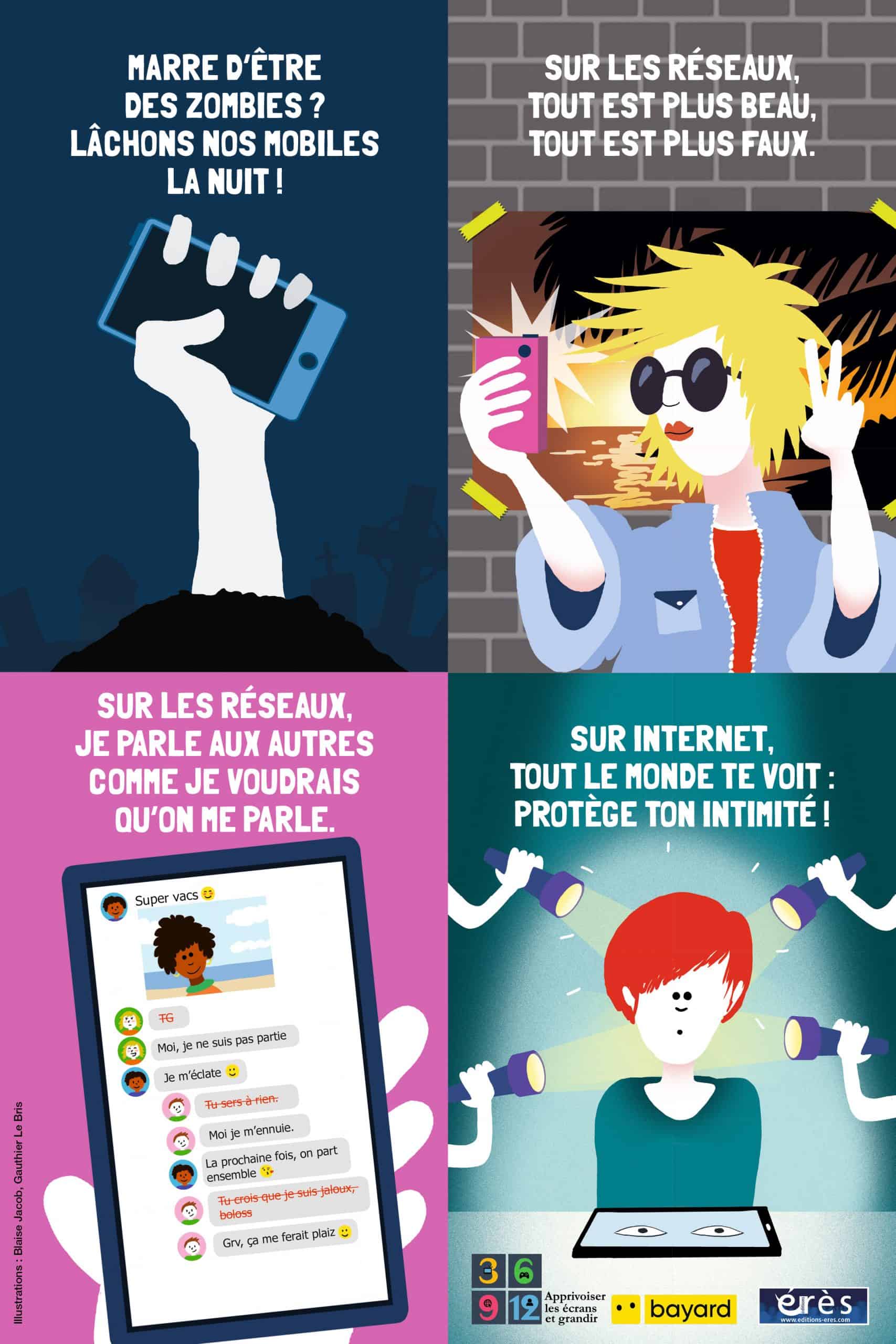
And let’s explain the 3 rules of the Internet: anything you put online can become public, anything you put online stays there forever, and you should not necessarily believe everything you find there.
Our advice: as a precaution, let’s put off buying our child a mobile phone for as long as possible, choose a device with limited features (a flip phone without Internet or touchscreen), and install an app that limits the time they can spend on it.

After 12: let’s stay available
Teenagers look more and more outside their family for their bearings, but they still need their parents’ loving attention, even if they do everything to make them believe otherwise!
Social media profiles should be set to private.
Relationships formed through screens (starting with social media and video games) are beneficial if they are maintained and strengthened by relationships in real life, especially with schoolmates.
No mobile phone in the bedroom at night: less sleep has problematic consequences for memory, mood, attention and concentration, eating habits and, of course, school performance.
Let’s limit time spent on video games: gains in quick decision-making and fast action come at the expense of the skills needed to step back and control impulses.
Our advice: let’s encourage our teenagers to use their devices purposefully, for specific activities rather than out of boredom, and not to eat in front of screens.

And at every age…
To enjoy screens without spending too much time on them, let’s ask ourselves each time whether it is the pleasure we find in them that keeps us there, or the wish to forget something that is worrying us. In the second case, we run the risk of no longer being able to put them down!