Available exclusively on Nintendo Switch
Like Fred & Jamy, we wanted to try an experiment. So we ordered some children on the internet, locked them in a chalet lost in the mountains, asked them to build things out of cardboard and to tell us afterwards what they thought. Not forgetting to feed them, of course; we are not monsters. To complete our methodology, we equipped ourselves with Toy-Con, from the Nintendo Labo programme. This flagship of modern technology combines the Switch with constructions made of… cardboard.
In the base box, Toy-Con 1: multi-kit to its friends, there are about twenty pre-cut sheets that make it possible to build five objects in total. The pieces are punched out, then assembled by following instructions given by the software running on the console. Its touchscreen lets you scroll through the instructions. By working through the steps, you can end up with a motorbike handlebar, a pair of remote-controlled “cars”, a fishing rod, a piano, and a house. We started with the first three.
Step 1 – Get hold of some children
Nintendo Labo is aimed above all at children. If you don’t have any to hand, skip straight to step four. In our case, we tracked down seven youngsters aged 5 to 11 and recorded their every move for a morning.

Step 2 – Cut out / Fold
For each of the constructions there is a whole pile of cardboard pieces to separate, fold, close and assemble. You need space and time. While the cars take only about ten minutes, the piano can take up to four hours to build, according to the notice on the box. In reality, the cars took twice as long for three six-year-olds with help, while the motorbike took us nearly two hours, for a team of four youngsters aged five, nine, ten and eleven. Good coordination is needed to avoid things going off the rails (meaning: you need an adult to share out the tasks, otherwise everyone tries to fold the same tab).
The pieces fit together perfectly and the explanations are clear enough that you easily understand what has to be done. The Switch, with its touchscreen, lends itself well to handling since you can rotate the model through three hundred and sixty degrees and zoom in on a detail of the assembly.


The Switch’s stand really comes into its own here! However, we again run into the problem of not being able to plug in the charger in this mode. You then have to lay the console flat, which is much less practical
Step 3 – Play
Once all the pieces are assembled and the parts decorated with coloured pencils, it’s time to play! The Switch then drops its role as instruction manual and slides into the cardboard supports (as do the Joy-Cons). By launching the corresponding game, you can interact by handling our cardboard structures. The motorbike handlebar lets you drive the machine around tracks, the fishing rod lets you explore the ocean depths and reel in to try to land the biggest fish, and the cars are driven remotely, using the infrared sensors as cameras. The house and the piano let you, respectively, interact with a sort of Tamagotchi and let the Mozart within you express itself. But within the strict framework of our experimental model, we did not test these last two items. The children rushed to the first three mini-games.

Bonus step: learn to take turns.

The motorbike handlebar is held against the chest and uses the cardboard add-ons (start, accelerate, brake), as well as the console’s gyroscopic properties (steering).

The deeper you let the bait sink, the bigger the fish. The sharks and rays have quite an effect on our guinea pigs.
Step 4 – And what do the adults think?
First observation: with a single Switch it is impossible to build several objects, so it is hard to make this a family experience with several children. Fortunately, some clever people have put the various instructions on YouTube, which makes it possible to split into several groups.

While I’m at it, I’d like to say a word about the software, which is seriously lacking in user-friendliness. It isn’t really easy to know where to find information, and when you’re looking for something specific, you often have to sit through all of the explanations. Even though you can speed up the scrolling, it’s still not very practical. It would have been welcome to find them in paper format in the box, as with a Lego set… or an IKEA piece of furniture. Several times I launched the wrong menu, and to get out of it I had to endure a semblance of dialogue between rather bland fictional characters, at high speed.
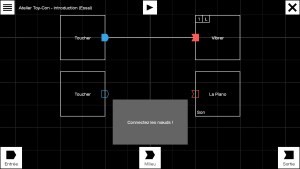
The software clearly has value as an introduction to programming and game design. But it undeniably requires support (or at least a minimum of encouragement).


The box states an age of six years, which does not correspond to the PEGI rating, but to the age from which children can take up origami. Our observation is that before nine or ten, it is hard to manage alone. That is not a bad thing; it is a chance to do a parent-child activity. But don’t count too much on your offspring managing on their own in a corner. Likewise, Nintendo Labo can be an introduction to programming concepts, but support will certainly be needed there too, since this part is by nature less intuitive.

Final step – Conclusion
There are good ideas in Nintendo Labo. Using vibrations to make the cars move is rather neat and the whole thing is very intuitive. However, after an hour of play (without overdoing it either), our cardboard toys were already starting to suffer the ravages of handling. After only a few uses (gently, and on a perfectly smooth table), the cars no longer went very straight. But it is above all the quality of the mini-games that is lacking. You quickly get through them all and even though our budding Valérie Damidots mostly enjoyed these games, we old killjoys aren’t sure the enthusiasm will last once the surprise has worn off.

The box of tricks: allow about €70 for the lot.

Breaking news: you can colour in with pencils that aren’t stamped “Nintendo Labo”.
Given the price of the box (€70 , we repeat), our recommendation would rather be to space out the builds. Plan, for example, a rainy day for the first one, build it and explore its possibilities, before scheduling the next for the following week. That way you will avoid ending up with a mountain of cardboard that quickly gathers dust (because it takes up a lot more room once assembled).
The verdict from those most concerned (just before we gave them back)
- Giulia, 6. Likes: the scooter going downhill. Dislikes: the scooter going uphill. “I liked building and playing afterwards”.
- Eva, 6. Likes: Splatoon 2 adverts on TV. Dislikes: experimental theatre. “The fishing rod was my favourite. In the game they look like real fish, it’s pretty. But it’s a shame we can’t eat them”.
- Eliott, 11. Likes: Reading, a lot, an enormous amount. And Fortnite. Dislikes: Brussels sprouts. “The fishing game was the most fun because it needed good reflexes. The motorbike is a shame because it has the most possible interactions, but it doesn’t respond very well”.
- Charline, 10. Likes: reading (passionately) and pottery. Dislikes: her father’s friends’ jokes. “The motorbike was fun! I liked playing more than building, because it took a bit long”.
- Sophie, 10. Likes: Pichu and unicorns. Dislikes: Fortnite. “The motorbike is the game I liked best, but I liked building more”.
- Hugo, 6. Likes: cars, lorries and anything that rolls. Dislikes: losing at table football. “The remote-controlled cars! But they didn’t work very well afterwards”.
- Alexis, 5. Likes: Big Flo & Oli and FC Barcelona. Dislikes: the wolf hiding in the basement of his school. “I liked playing the motorbike, more than building, it was a bit hard”.
No children were harmed during this experiment. As far as we know, anyway.

With a little setting up, it is possible to create collaborative synergy. Efficiency. Productivity. Profitability.
 To discover the game and its content by watching other players: https://goo.gl/UDSsZd
Find more articles on the site www.semperludo.com
He works in Switzerland on the issue of excessive screen use, notably with families. He uses video games as a therapeutic tool and keeps a close eye on developments in the medium (new releases, trends, impacts, etc.). Alongside his professional activities, he voluntarily runs a game review site (www.semperludo.com), as well as a nationwide association of gamers (www.gamingfederation.ch), through which they aim for responsible video game practice.
Twitter: @niels_weber, @semperludo, @GamingFed