Public health service of medical students at Sorbonne Université
A primary prevention project on the visual and psycho-behavioural risks
linked to screen overexposure
supervised by Connectome in Science, with the support of 3-6-9-12 +
Connectome in Science, an association that works to encourage interdisciplinary exchanges in science and medicine, supervised this year the public health service (SeSa) of third-year medical students at Sorbonne Université. Introduced at the start of the 2018-2019 academic year, the SeSa aims to promote students’ involvement in primary prevention actions through fieldwork missions. A project was thus set up to limit screen overexposure among young children and the appearance of associated visual and psycho-behavioural disorders. Excessive screen consumption is present from early childhood. Indeed, the Estéban study carried out between 2014 and 2016 shows that 72% of boys and 59% of girls aged 6-10 spend more than 2 hours a day in front of a screen1. The visual risks possibly linked to screens include dry eye syndrome (through impaired blinking), toxicity induced by “blue light”, and impaired growth of the eye (especially when exposure is early). Studies carried out in different countries show in particular that the reduction in outdoor activities and the increase in close-up activities during the lockdown linked to the COVID-19 epidemic are associated with a marked progression of myopia2. Furthermore, studies have shown a correlation between screen exposure and several learning or mental health disorders, although no causal link has been demonstrated3. Even so, excessive screen use, notably through exposure to unsuitable content, very probably affects the child’s development. This is why, in place of an unrealistic total prohibition, promoting a reasoned use adapted to the child’s needs is a major public health issue.
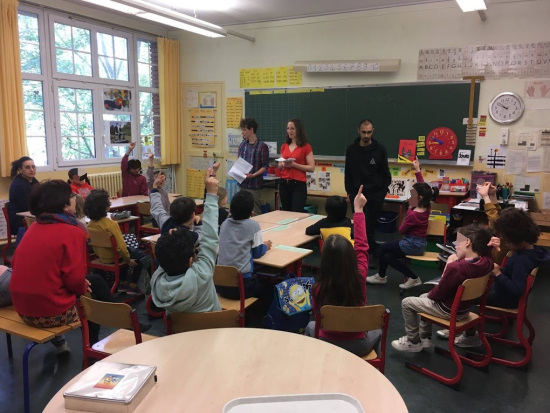
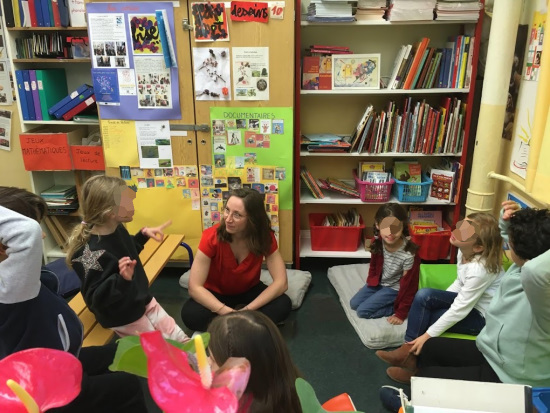
To do so, a team of six medical students supervised by Alexandre Dentel, an ophthalmology resident and Master’s student in Neuroscience, and Virginie Chotard, an orthoptist and PhD student in Neuroscience, ran prevention workshops in classes from CP to CE2 (ages 6 to 8) in 3 schools in the Paris region (Sorbier school in the 14th arrondissement, Delambre in the 20th and Albert Camus in Bondy). The aim was to act directly with the children, and as early as possible, in order to encourage reasoned use of screens from the youngest age. The 3-6-9-12+ association generously provided training to the students and supervisors to ensure appropriate, educational, relevant and impactful communication during the workshops, which were organised around 3 main areas :
- Guided group reflection on screen use, on the effects of screens on eating, sleep and vision, and on alternative activities to screens;
- Pooling of ideas and summary;
- Improvised plays, with four children playing a family (2 parents and 2 children), in 2 different situations (the doctor’s waiting room, and a domestic row in front of the television). The aim of the “parents” was to think of a way not to leave their “children” alone in front of a screen. Through theatrical play, the children were thus able to feel the difficulty their parents may have in finding alternatives to screens in various everyday situations, and were led to suggest solutions themselves.
Finally, all the advice given during the workshops was gathered on a flyer given to the children to encourage discussion with their parents. Thanks to the 3-6-9-12+ training, the emphasis was thus placed on the importance of varying activities, encouraging active use of screens, separating screen use from mealtimes and discussing content as a family. Furthermore, since it is important for the child to be an actor in their activities, a screen notebook was offered, on the advice of Dr Marie-Noëlle Clément, so that children learn to self-regulate their weekly screen time.
In total, the workshops were given in 16 classes of about fifteen children. At the end of the project, all the teachers were very satisfied with how the sessions went and with the messages conveyed. The medical students also greatly enjoyed the exercise.
References :
1. Verdot, C., Salanave, B., & Deschamps, V. (2020). Activité physique et sédentarité dans la population française. Situation en 2014–2016 et évolution depuis 2006–2007. Bull Epidémiol Hebd, 15, 296-304.
2. Limwattanayingyong, J., Amornpetchsathaporn, A., Chainakul, M., Grzybowski, A., & Ruamviboonsuk, P. (2022). The Association Between Environmental and Social Factors and Myopia: A Review of Evidence From COVID-19 Pandemic. Frontiers in Public Health, 1980.
3. Li, C., Cheng, G., Sha, T., Cheng, W., & Yan, Y. (2020). The relationships between screen use and health indicators among infants, toddlers, and preschoolers: A meta-analysis and systematic review. International journal of environmental research and public health, 17(19), 7324.
To access the flyer: https://www.3-6-9-12.org/wp-content/uploads/Flyer-prevention-ecrans-final.pdf
Virginie Chotard & Alexandre Dentel