In a world where technology is evolving at lightning speed, the question of the impact of screens on our lives, and on those of our children, is becoming ever more pressing. It is in this context that Serge Tisseron, with this expanded edition of 3-6-9-12+ Apprivoiser les écrans et grandir (Eres) offers us an enriched update of his research and reflections on this subject.
But today, the development of AI obliges us in the same way to set limits on how our children use chatbots. These are the “3-6-13-18 milestones for taming AI“, presented notably in his latest book Machines maternelles, l’IA peut-elle prendre soin de nous ? (Puf). The aim is to enable our children to grow up making the most of the digital tools at their disposal while avoiding the pitfalls they can present, and to continue laying the foundations of a connected, responsible, creative and supportive society.
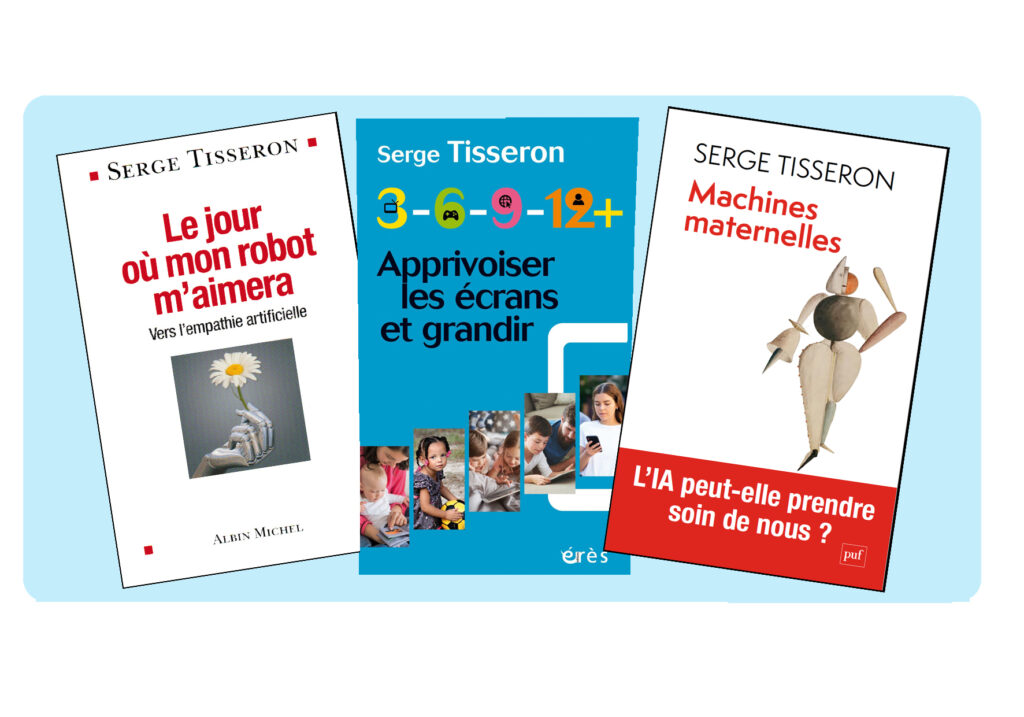
This book is therefore indispensable for everyone wondering about the role of screens in our society and about how to prepare new generations to navigate this connected world in an ethical and balanced way. To find out more and to get this essential guide, visit the publisher Érès.
Summary of the book 3-6-9-12+
Digital tools are upending every area: our relationship to knowledge and learning, the construction of identity and the forms of social bonds. At any moment we can choose to use them to multiply our possibilities of acting on the world, or on the contrary to flee from it and ignore it, in practices that quickly become pathological, from video games to social networks. To enable our children to come down on the right side, Serge Tisseron proposes the 3-6-9-12 milestones to guide parents and educators in achieving this by introducing screens into their lives at the right time and in the right way. They rest on three educational principles: alternating activities with and without screens, accompaniment and learning autonomy. The result is four pieces of advice valid for all children, whatever their age: choose quality programmes with them, limit screen time, talk about what they see and do on screens, and encourage creative practices, with or without digital tools.
Summary of the book Le Jour Où Mon Robot M’aimera
They are already among us but we do not see them. They are all our connected objects that detect our reactions, adapt to us, and sometimes even steer our choices without our knowledge. Soon, some of them will have a human appearance, decipher our emotions, talk to us, and may even show us affection, even love. Will that be “fake”? So what? We will only have to forget it to be happy.
But do we want that kind of happiness? How will we react to knowing we are under permanent surveillance? And what will become of the relationship between people when we are surrounded by humanoid creatures programmed to know everything about us and anticipate even our most secret desires?
This is not science fiction: it is urgent to think about it and to prepare our children for tomorrow’s world.
Summary of the book Machines Maternelles
In just a few months, chatbots have become unavoidable partners in our daily lives: family assistance, education, virtual friendship, romantic companionship, when they do not become our coaches or our therapists. Children use them at ever younger ages, with manufacturers offering connected soft toys from the age of 3 as an alternative to screens. AI is thus becoming a GPS for emotional life, an always-available confidant, a relational substitute and, for some, a space of wonder on encountering an unprecedented experience.
But what psychological mechanisms do AIs mobilise to penetrate our intimacy to this extent and sustain endless interactions, at the possible price of a soft hold over our imagination and our freedom?
Starting from the idea that we do not have one brain dedicated to objects and another to humans, Serge Tisseron suggests several avenues around the similarity of the interactions we establish with our fellow humans and with these machines, such as attachment, the maternal relationship or the discovery of the object. He also proposes a few new concepts to understand the mechanisms and consequences of these interactions, such as android thinking, system zero and degrees of personhood.