
Manifesto





📜 Our mission in 2026
Ever since my book published in 1998, “Y a-t-il un pilote dans l’image, six propositions pour lutter contre les dangers des images” (Is there a pilot in the image? Six proposals to fight the dangers of images), I have been campaigning for a reasoned use of screen-based technologies. Democracies can only thrive if, from the earliest possible age, they develop in children the civic skills that consist in everyone taking an active part in examining and questioning what concerns them.
Today, these skills are both enhanced and threatened by the power of digital tools. Enhanced for those who know how to use them, diminished for those who get trapped in compulsive and repetitive behaviours in which they surrender their freedom to algorithms. Tomorrow, the only children able to navigate the digital society will be those who know how these algorithms are designed to hold their attention ever longer, extract ever more personal data from them and make them buy ever more real or virtual goods. But in this area, social disparities are considerable: parents who are unable to acquire this expertise for themselves are obviously unable to pass it on to their children. Only schools have the power to reduce these inequalities. And this learning can rely on a reasoned, supervised use of screens, even though other means are of course available. This requires never leaving a child alone in front of a screen, and encouraging group work and project-based learning, in order to develop in children not only critical thinking but also curiosity about other people’s experience. Finally, let’s not forget to give our children access to a variety of activities, especially outdoors, so that they can develop bonds of solidarity: this is obviously the role of urban policy. As for the regulation of platforms, Europe is far ahead in this field, even if much remains to be done.
The fact that the 3-6-9-12 milestones received the prestigious Award of the Family Online Safety Institute in Washington in 2013 confirmed to me the soundness of the approach I initiated in 2008, first with the milestones themselves, then with the creation of the association behind them, and today with the broadening of these milestones symbolised by our new logo: 3-6-9-12+.
Finally, let’s not forget that AI now raises new challenges. By gradually blurring the line between humans and talking machines, it makes the creation of digital citizenship even more urgent. This requires educating children and adults, making algorithms understandable, and also sharing knowledge by creating groups for exchanging experiences and intergenerational mutual support, in companies and in schools. There is no better protection against the misuses and pitfalls of AI than education, collective intelligence and democratic debate.
—–
Serge Tisseron
Psychiatrist, member of the French Academy of Technologies, doctor of psychology accredited to supervise research in Clinical Human Sciences, associate researcher at the Université de Paris. Website: http://www.sergetisseron.com
🏆 International award: the 2013 FOSI Award
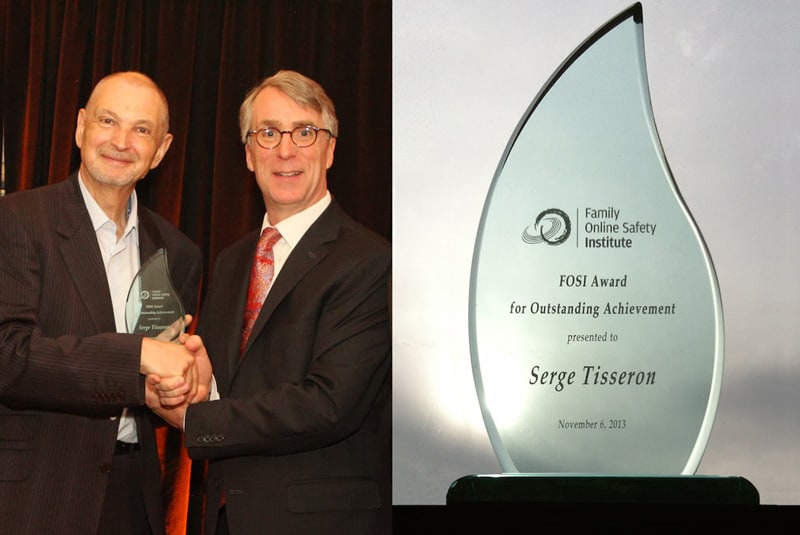
The Family Online Safety Institute is an international non-profit organisation working to make the online world safer for children and their families. FOSI brings together leaders from industry, government and the non-profit sector to collaborate and innovate new solutions in the field of online safety. Through research, resources, events and special projects, FOSI promotes a culture of responsibility online and encourages a sense of digital citizenship for all.
With round tables, forums and conferences around the world, FOSI plays an important role in leading the international debate.
On 6 November 2013, in Washington, in the auditorium of the Ronald Reagan Building and International Trade Center, in front of several hundred people, Serge Tisseron received from the hands of the President of FOSI the organisation’s highest distinction for his 3-6-9-12 milestones campaign.